蒔絵手帖 13
「雀蒔絵」

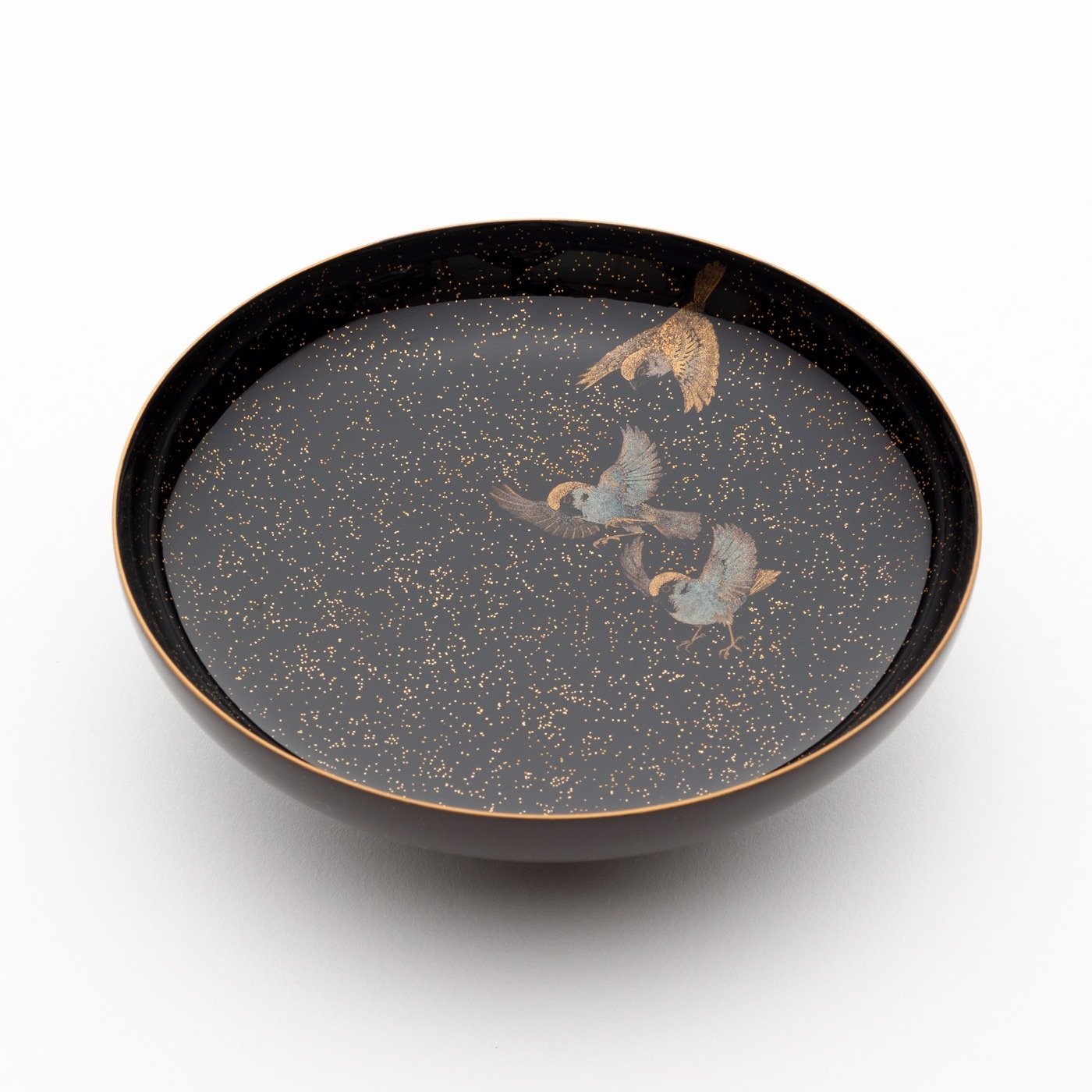
「三雀蒔絵杯」
冬の雀は羽毛をふくらませて、ふっくらと丸くなったかわいらしい姿を冬雀、ふくら雀と呼びますよね。この酒杯の雀は、冬になる前の秋の雀なので、まだふっくらしていません。恵みの秋は雀も活動的ですから、その躍動感を写実的に表現してみました。

雀の動きというのは、観察していても速すぎてよくわからないですよね。着地する時は、安定するように足を大きく開いて、爪を立たせているんじゃないかとか、想像しながら描いています。
僕は鳥の中で雀がいちばん好きなんです。見た目も茶と白と黒で地味なんだけれどきれいで、ほっぺに黒いのがあって可愛いんですよね。雰囲気がとても日本的だし、どこにでもいるから身近で親しみもあります。
その姿を、漆と金と銀だけで描いています。色漆など着色のものは使っていませんが、隣り合う金属の素材を変えたり、その金属粉の大きさを変えたり、漆とのバランスなどいろいろ考えて使っていくと、光の反射や銀の錆の変化で、羽が少し青っぽく見えたり、肌色っぽく見えたりと変化するんです。
In winter, sparrows puff out their feathers and look so cute and round—we call them 'Fuyu-suzume' (winter sparrows) or 'Fukura-suzume' (puffed sparrows) in Japan, don't we? The sparrows on this sake cup are from autumn, before winter arrives, so they aren't plump just yet. Since the bountiful autumn is a very active time for them, I tried to realistically capture that lively sense of movement.
Even when you observe them closely, sparrows move so fast that it’s hard to tell exactly how they’re moving, isn't it? While I'm working with the makie, I find myself imagining things like, 'I bet they spread their legs wide and dig their claws in to stay steady when they land.
Actually, out of all birds, the sparrow is my absolute favorite. Their colors—brown, white, and black—are simple, but they’re so beautiful, and those dark patches on their cheeks are just so cute. They have a very Japanese feel to them, and since they’re everywhere, they feel close and familiar.
I’ve depicted them using only lacquer, gold, and silver. I don’t use any colored lacquers. Instead, I carefully choose different metals to place side by side, vary the size of the metal powders, and balance them with the lacquer. By doing this, the way the light reflects and the way the silver naturally tarnishes creates subtle changes—sometimes the feathers look a bit bluish, and other times they take on a warm skin tone.
「群雀蒔絵茶器」

秋の稲刈りが終わった後、田んぼにやってきた雀が餌をついばんでいる、という光景をイメージしています。
まだ地面には落穂がいっぱい落ちていて、豊作だということですよね。雀は昔から群れで行動することからも、子孫繁栄や豊作の象徴、縁起物とされています。

この茶器は、三雀蒔絵杯と同じ技法で、写実的に雀を表現をしました。雀を観察した時の印象で描いていますので、羽を少し伸ばして長くしてみたり、頭を大きくしてみたり、描きながらバランスで調整していく感じです。
蓋の方には羽をひろげて舞う、豊作をよろこぶ雀の姿を、本体の下の方には、群がって黄金色の落穂をついばむ雀の姿を描いています。

蓋を開けると、茶器の内側と蓋の内側にも、金の平目粉がひろがっています。豊作につながるよろこびのイメージでもあります。

蓋をして茶器を金箔を施した敷板の上に置くと、下から発光しているように反射して、落穂に見立てた細かな金の平目粉が輝きます。また、敷板を黒いものにすると、金の落穂は沈み込んで、雀の細部が浮き出てくるんです。
茶室では畳の色が金色に近いので、発光しているように見えるかもしれませんね。お道具拝見の時には手に取って見ますから、角度によって雀が浮き上がって見えるのではないでしょうか。
-
「群雀蒔絵茶器」 「群雀蒔絵大棗」については下記よりお問い合わせください。
» filament お問い合わせ
I imagined a scene where sparrows have come to the rice fields to peck at grain after the autumn harvest.
There are still plenty of fallen ears of rice on the ground, which tells us it was a bountiful year, doesn't it? Since sparrows have always moved in flocks, they are seen as symbols of prosperity and good harvests—very lucky charms.
For this tea caddy, I used the same makie techniques as the "Three Sparrows Makie Sake Cup" to depict them realistically. I draw them based on the impressions I get from observing them, so I adjust the balance as I go—maybe making the wings a bit longer or the heads a little larger.
On the lid, I’ve depicted sparrows spreading their wings as if dancing with joy over the harvest. On the lower part of the caddy, you can see them flocking together to peck at the golden fallen ears of rice.
When you open the lid, you’ll find gold hirame-fun (flat-grained powder) scattered across the inside of both the caddy and the lid. This represents the joy that comes with a great harvest.
If you place the caddy on a gold-leafed board, the light reflects upward as if it's glowing from below, making the fine gold powder—meant to look like fallen rice—shimmer beautifully. On the other hand, if you use a black board, the shine of the gold rice becomes more subdued, and the fine patterns of the sparrows stand out.
In a tea room, the tatami mats are close to a golden color, so the caddy might look like it’s glowing. During the appreciation of the utensils in the tea ceremony, you’ll be holding it in your hands; depending on the angle, the sparrows may appear to rise to the surface.
-
Please reach out if you need more information or have any inquiries regarding the collection.
» filament Order / Inquiry Form
「群雀蒔絵大棗」

この大棗は、雀を写実ではなく、文様化して表現しています。雀のパターンとして3〜4種類のポーズがあって、それを連続して配置しました。
地模様は「
秋の稲刈りをした後というのは、どことなく埃っぽいんですよね。そこに太陽の光が当たるとキラキラして、平塵でその光景を表現しているというのもあります。
僕の故郷は秋田なんですけれど、まわりは田んぼで、秋と言ったら稲刈りをした後の匂い、埃っぽさという印象が僕の中にきっとあるんでしょうね。
そういうところに群がって雀が来るということは、豊作の象徴で縁起物ですね。

蒔絵の表現方法はたくさんあって、写実は自然の形に近い表現になりますが、文様化するとちょっと可愛い感じになって、連続文様でリズムが生まれてきます。
文様化すると生々しくないので、安心して見られるのではないでしょうか。
大棗が実際に使われるシーンを考えると、たくさんの方がいらっしゃる茶会では、あまり写実的だと生々しい感じになりますが、文様化されていると「雀ですね」とどなたにもすんなり受け入れてもらえる気がします。
茶道具は取り合わせですから、ほかの道具とも馴染みやすいかもしれません。

大棗の内側は真っ黒にしました。漆の黒って吸い込まれるような黒で、漆黒という言葉も、その世界を表すものですよね。
この黒の中に抹茶が入って、緑の山ができると、本当にきれいだと思います。
蓋を閉じる時には、どの位置でも文様を合わせられるようにしました。

この大棗もですけれど、僕は渋好みなんですね。派手なものは、僕にはいきなりゴールみたいな気がしてしまって。それより、渋いものには含みとか、幅とかがあって、見る人もそこをあっち行ったりこっち行ったりできる。そういう表現の仕方の方が、奥深い楽しさがあると思っています。
目の前のものに当てはまる言葉があまりなくて、そこに近寄るためにいろいろな言葉を言ってみたりしますけれど、それこそが深みのような気がします。
-
「群雀蒔絵茶器」 「群雀蒔絵大棗」については下記よりお問い合わせください。
» filament お問い合わせ
For this grand tea caddy, I’ve depicted the sparrows as stylized patterns rather than realistic figures. I created three or four different poses for the birds and arranged them in a repeating sequence.
The background pattern is called Heijin (one of the techniques of makie). I was inspired by the makie styles often seen in the Heian period—I really love that kind of atmosphere. After the autumn harvest, the air in the fields feels a bit dusty, doesn't it? When the sunlight hits that dust, it sparkles. I wanted to express that specific scene using the Heijin technique.
My hometown is Akita, surrounded by rice fields. For me, autumn always brings back memories of the scent of harvest and that dusty air. Seeing flocks of sparrows gather in such a place is a symbol of a bountiful harvest and good fortune.
There are many ways to express things in makie. While realism stays close to natural forms, stylizing a design makes it feel a bit more charming and creates a sense of rhythm through repetition.
Since stylized patterns aren't too "raw" or lifelike, I think they offer a sense of comfort. Considering how a large tea caddy is used—especially at a tea gathering with many guests—a realistic depiction can sometimes feel too intense.If it's a pattern, everyone can simply enjoy it, thinking, "Oh, look, sparrows."
It also makes it easier to harmonize with other tea utensils.
I made the interior of the caddy pure black. The black of lacquer has a depth that seems to draw you in—the Japanese word shikkoku (jet black) truly describes that world. I think it will look beautiful when the green mound of matcha is placed inside this deep blackness.
The design allows you to close the lid in any position without worrying about the pattern.
As with this caddy, my personal taste leans toward a sense of refined tranquility and calm. To me, something flashy feels like it’s already reached the "finish line."
As with this caddy, my personal taste leans toward a sense of refined tranquility and calm. To me, something flashy feels like it’s already reached the 'finish line.' On the other hand, things that possess a subdued, refined depth have a certain breadth to them. They allow the viewer to let their mind wander back and forth. I believe that kind of expression offers a deeper sense of enjoyment."
Sometimes, there aren't enough words to perfectly describe what’s right in front of us, so we try different words just to get a little closer to it. I feel that very process is where true "depth" lies.
-
Please reach out if you need more information or have any inquiries regarding the collection.
» filament Order / Inquiry Form